
The Chaos Every Dog Owner Knows — And the Simple Fix That Changes Everything
Picture this: It is 7 a.m. Your dog is already spinning at the door. You clip the leash, grab your keys, stuff your phone in one pocket and a crumpled poop bag in the other, and head out — only to realize, three blocks in, that you left the treats on the counter. Again.
Sound familiar? You are not alone. A 2024 survey by the American Pet Products Association found that dog owners walk their pets an average of 4.5 times per week. That is hundreds of walks per year, and for most owners, each one involves the same frantic juggling act: leash in one hand, used poop bag dangling from the other, phone buzzing in a pocket you can’t reach without letting go of everything else.
The solution is not a bigger jacket or a better pair of cargo pants. It is a dog walking waist pack — a purpose-built piece of gear that seasoned dog owners, professional trainers, and canine behaviorists have quietly relied on for years.
In this guide, we go beyond the basics. Drawing on input from certified professional dog trainers (CPDTs), veterinary behaviorists, and the real-world experience of everyday dog owners, we break down exactly what to look for in a dog walking fanny pack, how the right gear can actually improve your dog’s behavior, and why not all dog walking belt bag options are created equal.
Why Your Current Setup Is Working Against You (And Your Dog)

Before we talk solutions, it is worth understanding the real cost of walking unprepared — because it goes beyond personal inconvenience.
Certified Professional Dog Trainer Sarah Hodges, who has worked with reactive dogs for over a decade, puts it plainly: “The number one thing that undermines training on a walk is delayed reward delivery. If a dog sits on cue and the owner spends five seconds digging through a pocket for a treat, the learning window has closed. The dog has already moved on mentally.”
Five seconds sounds trivial. In dog training, it is an eternity. Studies in applied animal behavior consistently show that reward timing within one to two seconds of a desired behavior produces significantly stronger learning outcomes than delayed reinforcement. When your treats are buried in a coat pocket or a zipped bag you have to stop to open, you are not just inconvenienced — you are actively slowing your dog’s progress.
Beyond training, there is a safety dimension that rarely gets discussed. When both hands are occupied — one gripping a leash, the other holding a waste bag, keys, or a coffee cup — your grip strength and reaction speed are compromised. If your dog spots a squirrel and lunges without warning, a split second of fumbling is all it takes to lose control of the leash. A hands-free setup keeps at least one hand reliably free and fully functional at all times.
This is the case for a dedicated dog walking waist pack. Not as a fashion accessory. As a genuine tool for safer, smarter walks.
Understanding the Different Types: Not All Packs Are the Same
The market is flooded with options marketed as “dog walking” gear, but the terminology is inconsistently used. Here is a clear breakdown of the main categories and who each one actually suits.
1. The Dog Walking Fanny Pack: The Everyday All-Rounder
The dog walking fanny pack is the most popular choice for a reason: it balances capacity, accessibility, and wearability better than any other style. Worn around the waist or diagonally across the chest as a crossbody bag, a well-designed fanny pack will typically offer a main zipped compartment large enough for a phone, slim wallet, and small essentials, a front or side pocket dedicated to treats with easy one-handed access, and an integrated poop bag dispenser with a port or loop for used bags.
What separates a dog-specific fanny pack from a generic fashion version is the interior layout. Dog walking versions are engineered around the workflow of an actual walk: the treat pocket is positioned for dominant-hand access, the waste bag port is usually on the left side so it does not interfere with leash handling, and materials are chosen to be wipe-clean rather than fabric-only.
Best for: Daily neighborhood walks, urban environments, dog park visits, and owners who want one bag that does everything without looking like they raided a sporting goods store.
2. The Dog Walking Belt Bag: Streamlined Minimalism
If the fanny pack is the Swiss Army knife, the dog walking belt bag is the scalpel. Slimmer, lighter, and designed to lie almost flat against the body, a belt bag sacrifices volume for precision. You typically get room for a waste bag roll, one or two keys, a small pouch of treats, and not much else.
For runners and joggers who walk their dogs, this is often the superior choice. A belt bag with an elasticated band moves with the body rather than bouncing against the hip — a distinction that matters enormously after the first mile. Many competitive canicross athletes (who run with their dogs tethered to a waist harness) use a minimalist belt bag as their secondary carry for treats and waste bags, keeping the primary harness belt clean for the leash attachment.
Best for: Quick morning potty walks, jogging or running with dogs, minimalist owners, and urban walkers who do not want to carry any more than strictly necessary.
3. The Dog Walking Pack: Built for the Trails
Step up to serious outdoor terrain and the lightweight fanny pack no longer cuts it. A heavy-duty dog walking pack — sometimes called a trail utility belt or canicross pack — is built around the demands of extended outdoor use. Expect padded waist support to distribute weight across the hips rather than a single belt loop, a dedicated water bottle or hydration bladder pocket, D-rings or attachment loops for clipping a hands-free bungee leash directly to the belt (eliminating the need to hold the leash at all), and multiple compartments for trail-specific items like a collapsible bowl, first aid supplies, or extra waste bags for multi-dog walkers.
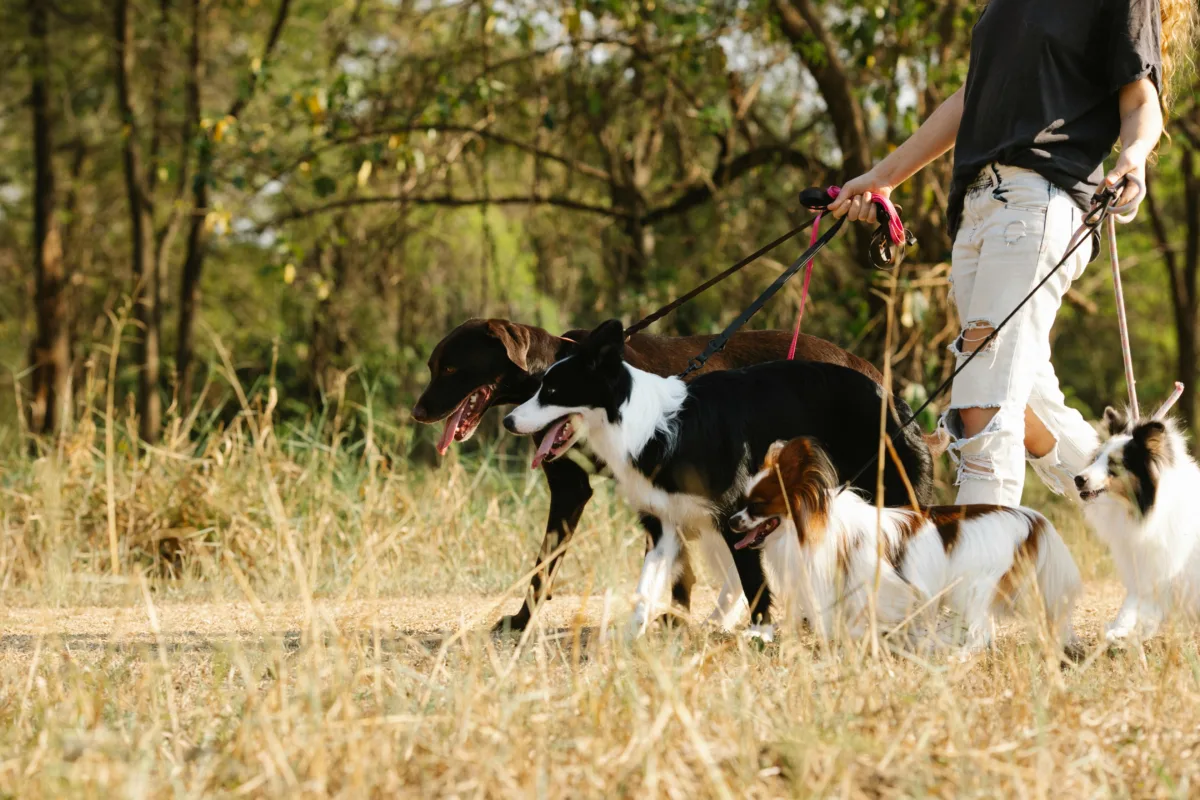
Professional dog walkers — those managing three, four, or five dogs simultaneously — often gravitate toward this style not for the trail capacity, but for the structural support. Holding multiple leashes for an hour produces real physical strain. A padded pack distributes that load more intelligently.
Best for: Hiking, trail walking, canicross, professional dog walkers, and anyone covering more than 45 minutes of walking terrain regularly.
The Six Features That Separate Good Packs from Great Ones
Once you have identified your style category, the next step is evaluating individual products. Here are the six features that consistently separate high-quality dog walking waist pack options from the ones that end up forgotten at the back of a cupboard.
1. Material and Weather Resistance
Dog walking is not a fair-weather activity. A quality pack should handle rain, mud, and the occasional enthusiastic wet-dog greeting without deteriorating. Look for 600D polyester or ripstop nylon as base materials, sealed or water-resistant zipper coils rather than standard open-weave zippers, and a DWR (Durable Water Repellent) coating on the outer fabric. Avoid canvas-only options for daily use — they absorb moisture and take days to dry fully, making them impractical in wetter climates.
2. The Poop Bag Dispenser
This single feature distinguishes a true dog walking fanny pack from a repurposed fashion bag more than anything else. A purpose-built dispenser features a small rubber-edged port — usually on the side or base of the pack — through which you thread the end of a standard roll of waste bags. You pull out one bag at a time without opening any zipper. This sounds like a minor convenience. Over the course of a year of daily walks, it is the difference between a seamless routine and a daily frustration.
3. Treat Pouch Design and Liner
Not all treat compartments are equal. The gold standard, recommended by professional trainers, is a magnetic closure rather than a zipper or drawstring. Magnetic closures open and close silently with one hand — critical during training when you need to reward without breaking eye contact with your dog or drawing attention to the treat delivery. The interior lining matters just as much as the closure. Silicone-lined or removable fabric liners are far easier to clean than raw nylon interiors, which absorb grease from high-value training treats and become rancid within weeks.
4. Reflective Elements
According to the Road Safety Foundation, pedestrian visibility is a leading factor in low-light traffic incidents. Reflective piping, strips, or logo detailing on your dog walking belt bag dramatically increases your visibility to drivers during early morning or evening walks — a non-negotiable for year-round dog owners in northern latitudes where winter walks happen almost entirely in darkness.
5. Ergonomic Fit and Adjustability
A pack that fits poorly will migrate, chafe, or restrict movement. Look for a wide, adjustable waistband with at least 15 inches of adjustment range to accommodate different body types and layering (you will wear this over a t-shirt in summer and a winter coat in January). Packs with a sternum strap or hip stabilizer perform better during faster-paced walking or light jogging, keeping the bag stable without constant manual re-adjustment.
6. Leash Management Integration
Higher-end dog walking pack models include external D-rings or carabiner attachment points on the front or sides. These allow you to clip a spare leash, a retractable lead, or a used-bag hook directly to the pack rather than searching for a free hand to hold them. For multi-dog walkers, this integration is not a luxury — it is a workflow essential.
What to Actually Pack: A Walk-Ready Checklist
The right gear is only useful if it is loaded intelligently. Here is how professional dog walkers and trainers organize their packs for maximum efficiency.
Non-Negotiables (Every Walk): A full roll of waste bags loaded into the dispenser, house or car keys clipped to the internal key hook, a fully charged phone in the main compartment, and a small stack of pre-torn or pre-cut treat pieces in the treat pouch — not whole treats that require breaking mid-walk.
Training Essentials: High-value treats separate from everyday kibble. Think small pieces of dried liver, string cheese, or soft jerky. The general rule from professional trainers: the more distracting the environment, the higher the value of the treat needs to be. What works at home often does not work near a busy road.
Safety Additions: A small LED clip light for low-visibility conditions, a personal alarm or whistle for emergency recall or deterring aggressive dogs, and a spare carabiner for quick leash reconfiguration if you encounter an unexpected situation.
Extended Walk or Trail Additions (Dog Walking Pack): A collapsible silicone water bowl (most compress to under an inch thick), a tick removal card or tool (especially relevant in woodland areas between April and October), paw balm for hot pavements or rough trail surfaces, and a small emergency contact card with your dog’s name, breed, and vet details in case of separation.
Matching the Pack to Your Dog’s Personality
One dimension that rarely appears in product reviews but matters enormously in practice: your dog’s behavior profile should influence your pack choice as much as your own preferences.
If you walk a reactive dog — one that lunges, barks, or fixates on triggers — open-access treat delivery is your highest priority. Choose a dog walking fanny pack with a magnetic treat closure positioned on the dominant-hand side. You need to be able to reward a successful “leave it” or calm response before the moment passes.
If you walk a strong puller — a Labrador, a Husky, a young Vizsla — physical stability matters more. A crossbody or dual-strap configuration distributes the indirect force of leash tension more evenly than a single waist belt, reducing the risk of the pack twisting or sliding during sudden direction changes.
If your dog is recall-trained and walks largely off-leash in safe environments, a minimalist dog walking belt bag is your best match. You are not managing active leash tension, so structural support is secondary to comfort and low profile.
From Dog Park to Brunch: The Style Consideration
Functionality matters most. But we would be doing you a disservice if we ignored the fact that you will be wearing this pack in public, often in social settings, sometimes for hours at a time.
The good news: the market has evolved significantly. Premium dog walking fanny pack options now come in waxed canvas, vegan leather, and recycled nylon in muted, fashion-forward colorways that read as lifestyle accessories rather than utility gear. Several independent brands have built their entire identity around the intersection of dog ownership and streetwear aesthetics, producing packs that hold their own alongside high-end fashion bags.
If aesthetics matter to you — and there is no shame in that — look for packs where the dog-specific features (bag dispenser, treat liner) are discreetly integrated rather than loudly labeled. The best designs hide their utility entirely, revealing it only when you need it.
Conclusion: Walk Smarter, Not Harder
The daily dog walk is one of the most consistent rituals in a dog owner’s life. Over the course of a dog’s lifetime, you will log thousands of miles together. How you equip yourself for those miles is not a trivial decision.
A quality dog walking waist pack does not just organize your keys and treats. It keeps your hands free when it matters most, sharpens your training timing, improves your visibility and safety in low-light conditions, and — perhaps most importantly — removes the low-level friction that turns a joyful routine into a stressful one.
The right pack depends on your walking style, your dog’s behavior, and your own priorities. But the wrong pack — or no pack at all — costs you more than you realize on every single walk.
Whether you are a first-time dog owner building your kit from scratch or an experienced handler looking to upgrade, start with the features that match your actual routine, not the most impressive spec sheet. A slim dog walking belt bag worn consistently beats an overloaded dog walking pack that stays in the closet.
Equip well. Walk often. Your dog is already waiting at the door.